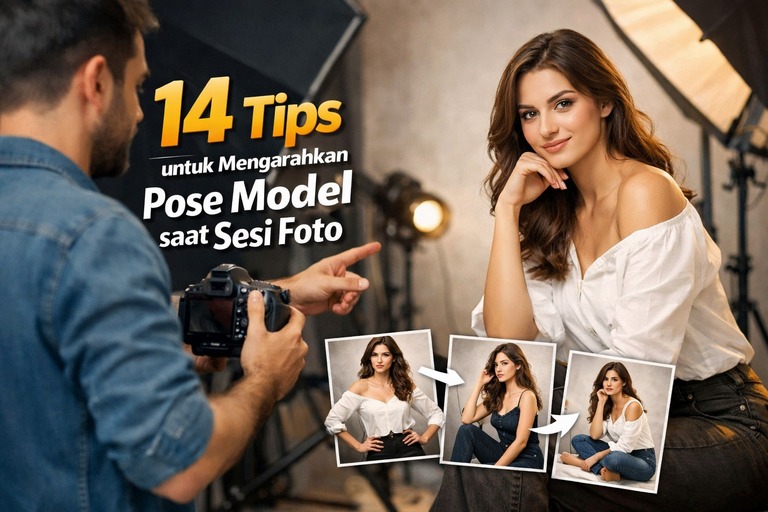
14 Tips to Direct a Model's Pose during a Photo session
Directing a model's pose during a photo shoot requires good communication, an understanding of composition, and the ability to read body expressions. Here are some tips that can help you direct a model's pose so that it looks natural and appealing:
1. Build Comfort and Confidence
- Before starting, talk to the model to establish convenience and confidence. Models who are relaxed will find it easier to follow directions and look more natural in front of the camera.
- Try give praise when models strike a good pose, it can help them feel more confident.
2. Clear and Simple Directions
- Give directions that simple and clear, such as “Tilt your head slightly to the right” or “Lean your shoulders forward.” Avoid complicated directions so that the model does not feel confused.
- Use your own body to model the pose if needed. Demonstrate with physical movements so that the model can understand your intent better.
3. Pay Attention to Posture
- Keep the posture Good posture, with upright shoulders and a straight back, but avoid postures that are too rigid. Encourage the model to slightly bend forward or leaning towards the camera to give a closer and more dynamic feel.
- Relaxed shoulders and slightly extended neck will give the impression of elegance and relaxation.
4. Variations in Body Angle and Position
- Body angle attractive poses are usually around 45 degrees from the camera, which helps to give depth and dimension to the image. Avoid poses with the model's body face to face to the camera as they often appear flat.
- Direct the model to try different sitting, standing, or half-squatting pose. Variations in body position can create different dynamics in a photo.
5. Natural Facial Expressions
- Ask the model to not always smiling; encourage them to try different expressions, from serious, to relaxed, to laughing. This gives more variety to the photo.
- Navigate eye gaze models to not always look directly at the camera. Try directing them to look sideways or downwards to create a more emotional and natural expression.
6. Watch Hands and Fingers
- Hand position can often make or break a pose. Relaxed hands looks more natural than a stiff hand. Make sure the model's hands are not too tense.
- Point the hand to interacting with the face, hair or accessories. For example, place one hand in the hair, one on the waist, or touch the neck to create a more organic pose.
7. Dynamic Pose
- Encourage the model to try more dynamic poses or in motion, such as walking, stepping, or turning. This gives the photo a lively and natural feel.
- Try taking photos when the model walking towards the camera or spinning with a smile, This can result in interesting candid moments.
8. Play Head and Neck Position
- Orient the model to tilt your head slightly or pull your chin forward to create a more defined jawline and better facial proportions.
- Vary the neck pose with positions that slightly tilted to the side, This often gives a more relaxed and elegant impression.
9. Navigate the Model Using Objects
- If there is props (e.g. a chair, wall, or other object), direct the model to interact with the object. For example, sitting on the edge of a chair, leaning against a wall, or holding a certain accessory. This adds dimension to the pose and gives it a more natural feel.
10. Focus on Small Details
- Often small details make a big difference in the pose. Pay attention to finger position, eye direction, curves on the body, and clothing lines. Correct if anything looks untidy or uncomfortable.
- For example, if the model is sitting, make sure leg pose not stiff and looks elegant.
11. Use Emotional Direction
- In addition to giving physical instructions, try giving emotional direction. For example, “Imagine you are waiting for someone you miss,” or “Try to remember a moment when you felt really happy.” This helps to create a more genuine expression.
12. Don't Be Afraid to Try Unique Poses
- Don't be afraid to experiment with unusual poses. Direct the model to do something that may be out of the ordinary, such as jumping, lying down, or asymmetrical poses.
- Unconventional poses often result in unique and artistic photos.
13. Create an Emotional Connection
- If you work with more than one model, create interaction between them. Have them talk, smile or laugh together to produce more natural expressions.
14. Group Photo Review
- Show some photos to the model in between sessions. This helps them to see how the poses they have done look, and can correct or improve any poses that they feel are not optimal.
With good direction, communication, and an understanding of effective posing, you can help the model look more comfortable and produce photos that are interesting and full of expression.
Also Read: Beyond Selfie: 5 Creative Photo Ideas You Can Try Today!



 English
  Indonesian