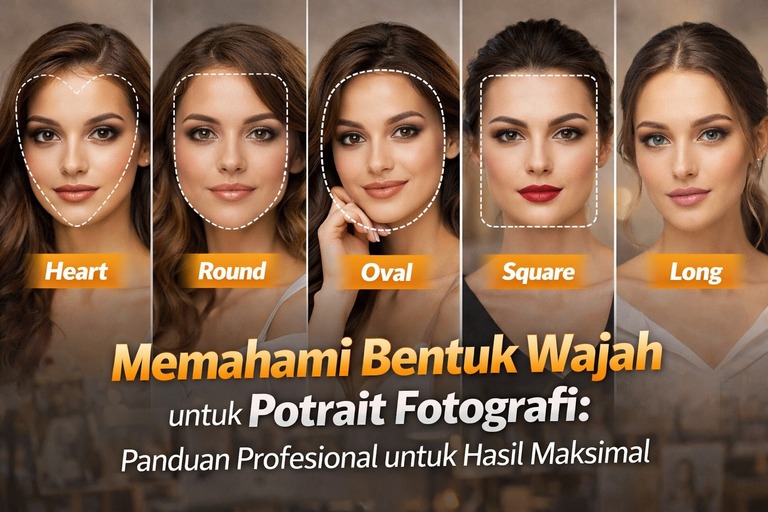
Understanding Face Shape for Portrait Photography: A Professional Guide for Maximum Results
Understanding face shapes for portrait photography is a fundamental step that is often overlooked by beginner photographers. Many think that good portraits are just a matter of expensive cameras or bokeh that is soft. In fact, the secret to an iconic portrait lies in how a photographer is able to read the anatomy of his subject and adjust lighting techniques and camera angles to accentuate strengths or disguise flaws.
In the professional world, human faces are categorized into several basic shapes: oval, round, square, heart, and long. Each of these shapes has different shadow characteristics when exposed to light. If you misplace the lights or choose the angle of view, a face that is supposed to look thin can appear wide, or a masculine face can lose its defined jawline.
1. Why is Facial Anatomy Key?
Before pressing the button shutter, A photographer acts like a painter. The light is your brush, and the subject's face is the canvas. By understanding face shapes for portrait photography, You no longer shoot speculatively. You shoot with intent.
For example, someone with a round face may want to look thinner. Here, your knowledge of Short Lighting will be very useful. On the other hand, a subject with a very thin face may need Broad Lighting to give a sense of volume. Without this understanding, the lighting technique you use will just be a “template” that doesn't necessarily work for everyone.
2. Recognizing 5 Basic Face Shapes and Their Photography Strategies
A. Oval Face Shape (The Standard)
The oval face is considered the most aesthetically proportionate shape traditionally. The forehead is slightly wider than the chin, with prominent cheekbones.
- Strategy: Almost all types of lighting are suitable for this shape. However, for dramatic results, try Rembrandt Lighting to give dimension to the cheekbones.
- Camera Angle: Eye-level is best.
B. Round Face Shape
A round face has almost the same width and length, with a soft, non-angled jawline.
- Strategy: Use Short Lighting. This technique illuminates the side of the face that is away from the camera, thus creating shadows on the side that is close to the camera. This visually “cuts” the width of the face and makes it appear more oval.
- Camera Angle: Take a slight angle from above (high angle) to help emphasize the jawline and reduce the impression of chubby cheeks.
C. Square Face Shape
Characterized by a broad forehead and a strong, angular jaw. This shape is great for a masculine impression or strong character.
- Strategy: Use soft light (soft light) to smooth out an overly hard jawline. Butterfly lighting (light from above the front) can help accentuate the cheekbones without widening the jaw.
- Camera Angle: Avoid shooting right from the front (flat). Have the subject turn their head slightly to the side to break up the rigid symmetry of the jaw.
D. Heart Face Shape
A wide forehead with a pointed or narrow chin.
- Strategy: Focus the light on the jaw and neck area to give the impression of width at the bottom. Avoid too much light on the forehead.
- Camera Angle: Low angle or chin-high angle can help make the chin look fuller and proportionate to the forehead.
E. Oval Face Shape (Long/Oblong)
A face that is much longer than it is wide.
- Strategy: Use Broad Lighting (illuminates the side of the face facing the camera). This will give the impression of a wider, more balanced face.
- Camera Angle: Avoid high angle extreme because it will make your face look longer. Eye level is the safest option.
3. The Role of Focal Length in Face Distortion
Understanding face shapes is incomplete without talking about lenses. Lenses wide-angle (e.g. 24mm or 35mm) tend to distort objects that are close to the lens. If you shoot close-up portraits with a wide lens, the subject's nose will appear larger and the facial proportions will be messed up.
For accurate portraits, use a short telephoto lens such as 85mm or 105mm. It provides sweet compression, making facial features look more natural and flatter, which subjects usually prefer. On MFT cameras such as your Lumix GH5, the 42.5mm f/1.7 is a secret weapon that provides an 85mm equivalent perspective at Full Frame.
4. Lighting Pattern: Carving the Face with Light
Light is not just about brightness, but about where shadows fall.
- Loop Lighting: Creates a small loop-shaped shadow next to the nose. Suitable for almost all face shapes.
- Split Lighting: Divides the face into two sides (light and dark). Great for hiding skin texture or creating a mysterious look on a wide face.
- Rembrandt Lighting: Characterized by the triangle of light under the eye on the dark side. Gives a very strong and artistic character.
5. Psychological Tips: Communication with the Subject
As a photographer, you need to be able to “analyze” your subject's face without making them feel uncomfortable. Don't say, “Your face is too round, I need to use the Short Lighting technique.” Instead, gently direct them: “Try turning your head to the right a little so that we can get a good reflection of your jawline.”
The comfort of the subject will affect the eye expression. A technically perfect face shape will be meaningless if the subject's expression looks tense or unconfident.
Conclusion
The art of portrait photography is a blend of technicality and empathy. With understanding face shapes for portrait photography, You are raising the level of your work from a mere “people photo” to a “work of art” that respects the unique anatomy of each individual. Remember that there is no such thing as a “bad” face shape, just poor lighting.
Keep experimenting with different light patterns and camera angles. Use this knowledge to build a portfolio that shows you are not just a camera wielder, but a visual expert who understands the smallest details of your subject.
Estimated reading time: 5 minutes


 English
  Indonesian