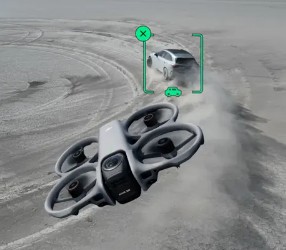
Pros and Cons of DJI Avata 360: Revolution or Just a Trend?
The world of aerial photography is once again rocked by the presence of the latest innovation from DJI. After the success of the previous Avata series, now comes the new DJI Avata 360, a drone that promises to combine the immersive flying sensation of FPV (First Person View) with the creative freedom of a 360-degree camera. Before you decide to splurge, it's important to have an in-depth understanding of what the advantages and disadvantages of DJI Avata 360 This is so that your investment doesn't go to waste.
DJI Avata 360 Pros: Why is this Drone So Interesting?
This drone is not just a design update. There are some revolutionary features that make it really stand out in the market.
1. The 8K 360 Degree Camera Revolution
The main advantage of this drone lies in its dual-lens system. In 360 mode, you can record videos with amazing resolution 8K at 60fps HDR. This provides absolute freedom during the process reframing in the editing stage, ensuring that your subject is always in the perfect frame without losing details.
2. Gyro Frame & Ease of Editing Features
DJI introduces the Gyro Frame which is very innovative in the DJI Fly app. This feature allows you to perform reframing 360 videos by simply moving smartphone You, providing an intuitive and fast editing experience. This greatly shortens post-production time.
3. High-level Security (Omnidirectional Sensing)
Despite its compact size, the DJI Avata 360 is equipped with the following features Omnidirectional Obstacle Sensing. The drone uses a 360 camera and a LiDAR sensor on the front to detect obstacles from all directions. Coupled with propeller protection (propeller guards), this drone is very safe to fly even by beginners or in tight areas.
DJI Avata 360 Cons: What are the Limitations?
For all its sophistication, this drone has some limitations that you need to consider.
1. Absence of Manual Mode (Full Acro)
For pure FPV pilots looking for total control to perform maneuvers freestyle, The absence of Manual or Acro mode is the biggest drawback. This drone is designed more as a safe creative tool, not a racing drone.
2. Background Quality in Large Landscapes
Despite the large sensor (1/1.1 inch), the lens ultra-wide used tends to produce background details that are a little “soft” (softer) in very large landscape shots. The image is maximized when flying closer to the subject.
3. Stitching Line Problems
360 cameras have always had challenges with connection lines (stitching line) where the two lens images meet. Although DJI continues to improve the smart stitching in DJI Studio, in some extreme conditions, these lines can still be slightly visible.
4. Lens Cover Prone to Scratches and cannot be added ND Filter
The convex shape of the camera lens is prone to scratches or bumps. The DJI Avata 360 also cannot be fitted with an ND filter, which we sometimes need to reduce the shutter speed.
Specification Comparison: DJI Avata 2 vs DJI Avata 360
(Focus Keyphrase appears for the 2nd time here)
To give you a clearer picture of the evolution of the technology, let's take a quick comparison between the previous series and the new DJI Avata 360:
| Features | DJI Avata 2 | DJI Avata 360 |
| Camera | Single Lens 4K | Dual Lens 8K 360 / Single 4K |
| Anti-collision Sensor | Forward/Downward | Omnidirectional (360 Degree) |
| Manual Mode | Support | Not Supportive (During Review) |
| Weight | Lighter | About 455 grams (Heavier) |
| Reframing Creativity | Limited | Very spacious |
Conclusion: Are You Worth It?
After weighing various advantages and disadvantages of DJI Avata 360, This drone is proving to be a very powerful tool powerful for content creators who prioritize safety and want to produce unique FPV visuals without limitations. framing traditional.
However, if you're a professional FPV pilot who needs extreme speed and control Full Acro, this drone is not for you. For most users, the ease of editing with Gyro Frame and safety assurance omni-sensing making it a very attractive investment.
Estimated reading time: 4 minutes
Table of contents
FAQ (Frequently Asked Questions)
The main advantages are the dual-lens camera capable of recording 360-degree videos in 8K 60fps resolution, the Omnidirectional Obstacle Sensing safety feature, and the ease of editing using the Gyro Frame feature in the DJI Fly app.
Currently, the DJI Avata 360 is more focused as a creative tool and does not yet support full Manual (Acro) mode. The drone only provides Normal and Sport modes to maintain flight safety and 360 footage stability.
In 360 mode, the drone produces 8K HDR resolution video at 60fps. While in single lens mode, it is capable of recording up to 4K 60fps HDR resolution.
The DJI Avata 360 battery has a maximum flight time of about 23 minutes, with an average real-world usage of about 20 minutes per flight.


 English
  Indonesian