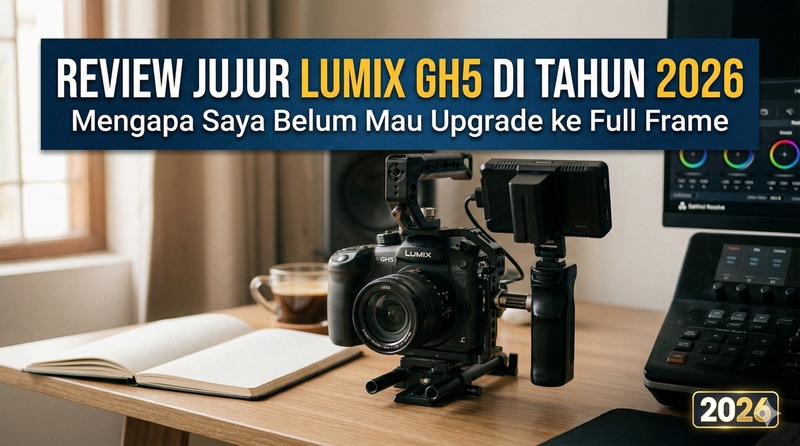
Honest Lumix GH5 Review in 2026: Why I'm Not Upgrading to Full Frame Yet
The world of videography in 2026 is going sensor crazy Full Frame. Every brand is competing to release high ISO cameras that are noise-free and bokeh-enhanced due to the advantages of a larger sensor. However, if you look into my camera bag, you'll still find the same stalwart that was released years ago: Panasonic Lumix GH5.
Many have asked, “Mas Agus, it's already 2026, why haven't you moved to Full Frame? Isn't it outdated?”
The answer is simple: Efficiency and Character. In this article, I will dissect the technical and practical reasons why the Lumix GH5 remains my “primary weapon” for professional video projects, even amidst the onslaught of large sensor technology.
1. A Mature and Cheap Micro Four Thirds (MFT) Ecosystem
One of the main reasons I stayed was the lenses. In 2026, lens prices Full Frame high quality is still a heavy investment. In contrast, the MFT ecosystem is very mature.
With the Lumix GH5, I can use lenses such as Leica 12-60mm or Lumix 25mm f/1.7 which is tiny in size but incredibly sharp. For video work, especially event videos, mobility is key. I can switch angles quickly without feeling like I'm holding a “brick” in my hand.
2. IBIS is Still the Gold Standard
Although the camera Full Frame While the latter have good internal stabilization (IBIS), their large sensor weight often makes the stabilizer work harder.
The smaller MFT sensor on the GH5 allows its stabilization system to work more agilely. For shooting handheld when interview or speech shooting, the GH5 delivers very organic results, resembling the movement of the gimbals without the need to carry any additional cumbersome tools.
3. “Lightweight” 10-bit Workflow in DaVinci Resolve
Many of the latest cameras offer 8K resolution, but honestly, do we really need it for social media or YouTube content?
The GH5's 4K 10-bit output is still very capable for color grading professional. When I pulled the color in DaVinci Resolve, the files from the GH5 feel very flexible yet not torturous hardware my computer. The file size is “just right”-it doesn't fill up the SSD as quickly as a RAW file. Full Frame.
4. Battery Life and Heat Management
This is the camera disease mirrorless modern: overheating. Multiple cameras Full Frame modern that died suddenly after recording 4K for 30 minutes.
The Lumix GH5 is a “tank”. I once filmed a community event for hours under the hot sun, and the GH5 never once gave me a heat warning. This kind of reliability cannot be bought with mere megapixel specifications.
Brief Comparison: MFT vs Full Frame (Practical Perspective)
| Features | Lumix GH5 (MFT) | Full Frame Camera (Average) |
| Mobility | Extremely Lightweight & Compact | Heavy & Requires a Large Bag |
| Lens Price | Affordable (Many Second Options) | Expensive & High Investment |
| Depth of Field | Deep (Suitable for detail focus) | Shallow (Excessive Bokeh) |
| Temperature Management | Very Stable | Prone to Overheat at High Resolution |
5. When Will I Finally Upgrade?
I am not anti-progress. I will move to Full Frame if my job demands performance low light extreme-such as recording a concert in a very dark room without additional lights. However, for daily documentation, profile videos, and creative content needs, the GH5 still delivers. Return on Investment (ROI) is much higher.
Conclusion
In 2026, the best camera won't be the one with the biggest sensor, but the one that you understand best and doesn't hamper your creativity due to technical or weight constraints.
The Lumix GH5 is not just an old tool; for me, it's an instrument that has become integrated into my workflow. I would like to buy a Lumix G100, mainly because of the lower price of the lens with a smaller and more compact lens size than full frame. If I could request, the Lumix G100 with the addition of IBIS would probably be enough for my professional needs, as it is more compact and lighter than the GH5. It is also rare to use the maximum quality of 10 bit 422, because one project can be hundreds of giga files.
Also Read: The Secret of Golden Composition: Make Your Photos a True Work of Art
What do you think? Are you still loyal to the small sensor or have you settled on the path of the Full Frame? Let's discuss in the comments!


 English
  Indonesian